
The Protective Role of Sensory Nerves in Tendon Health
This study by Zhu et al., published in Science Translational Medicine in May 2026, investigates the previously unclear role of sensory nerves in the development of tendinopathy. Although sensory nerves are traditionally associated with transmitting tendon pain, the researchers found evidence that they also have a protective role in maintaining tendon health.
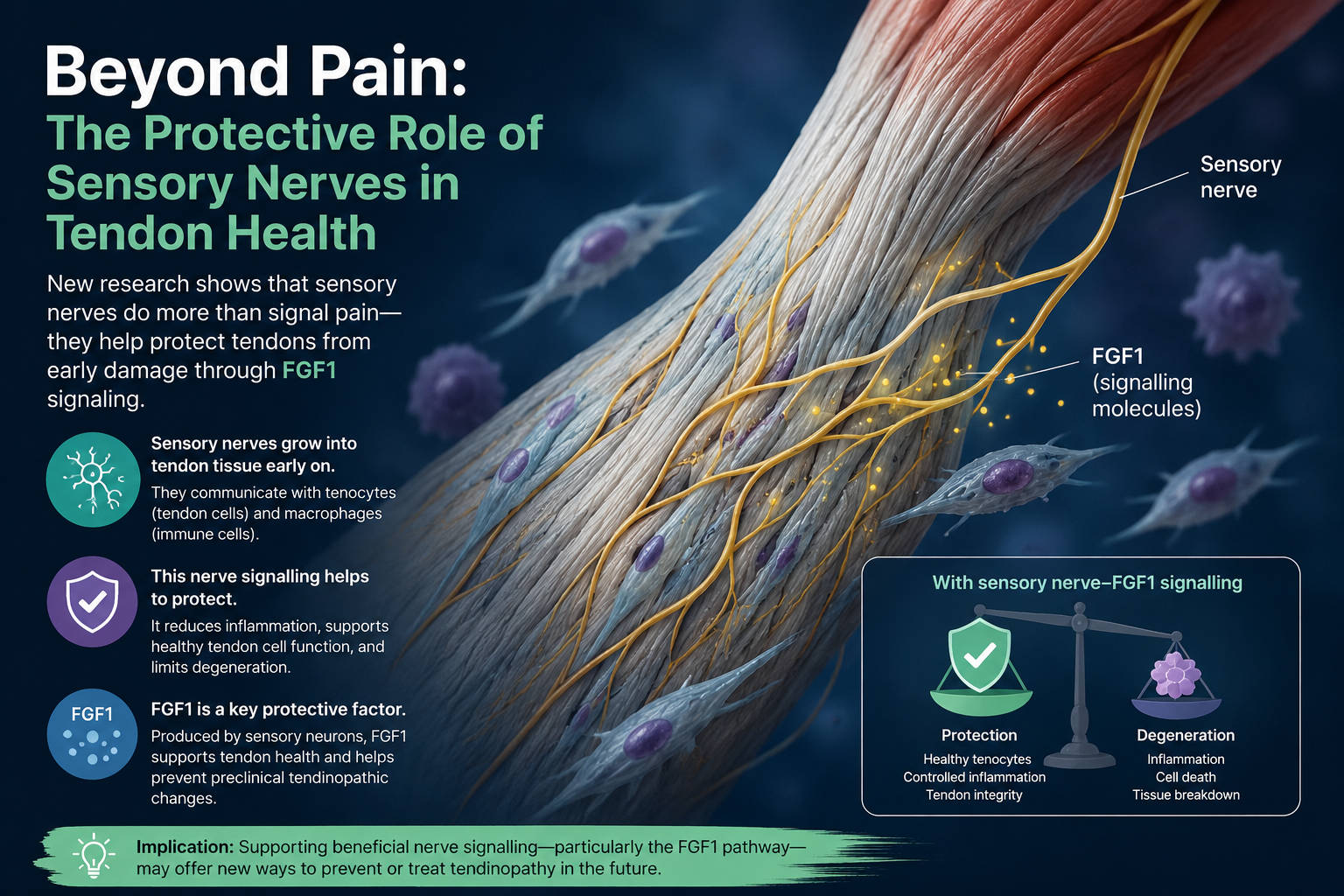
Using several mouse models of chronic Achilles tendinopathy, the researchers showed that sensory nerve fibres grow into tendon tissue during the early stages of tendinopathic change. These nerves interact with tenocytes (the cells responsible for maintaining tendon tissue) and macrophages (immune cells involved in inflammation and tissue repair). When sensory nerve growth or signalling was disrupted, tendon degeneration became more pronounced, with increased macrophage infiltration, greater tenocyte cell death and impaired tenocyte differentiation.
The study also examined the nerve growth factor (NGF)–TrkA pathway, which supports sensory nerve growth and function. Reducing NGF production by macrophages or disrupting TrkA signalling in sensory neurons worsened tendinopathic changes. Similarly, selective denervation of sensory nerves produced comparable effects, suggesting that the deterioration was specifically related to the loss of sensory nerve input rather than simply general nerve damage.
Single-cell RNA sequencing provided further evidence that denervation alters the behaviour of both tendon and immune cells. In particular, loss of sensory nerves was associated with abnormal tenocyte differentiation and changes in macrophage migration and polarisation. These findings suggest that sensory nerves help regulate the local tendon environment and may limit the inflammatory and degenerative processes that contribute to tendinopathy.
A key finding was the identification of fibroblast growth factor 1 (FGF1) as an important mediator of this protective effect. The researchers found that sensory neurons produce FGF1, which appears to help prevent tendon degeneration. Experiments using tendon organ cultures and animal models supported a protective role for FGF1. Importantly, human tendinopathy samples also showed FGF1 associated with nerve fibres supplying the tendon, suggesting that this mechanism may be relevant to human disease as well.
Overall significance
The study challenges the conventional view of sensory nerves as structures that primarily transmit pain in tendinopathy. Instead, it suggests that sensory nerves can actively protect tendon tissue, partly through FGF1 signalling and interactions with tenocytes and macrophages. The findings raise the possibility that therapies designed to preserve or enhance beneficial nerve–tendon signalling, particularly the FGF1 pathway, could help prevent or slow the development of tendinopathy.
However, the main experimental evidence comes from preclinical mouse models, so further research is needed to establish whether manipulating sensory nerve–FGF1 signalling can safely prevent or treat tendinopathy in humans.
