
Flexible but Flawed? New Research on Joint Hypermobility
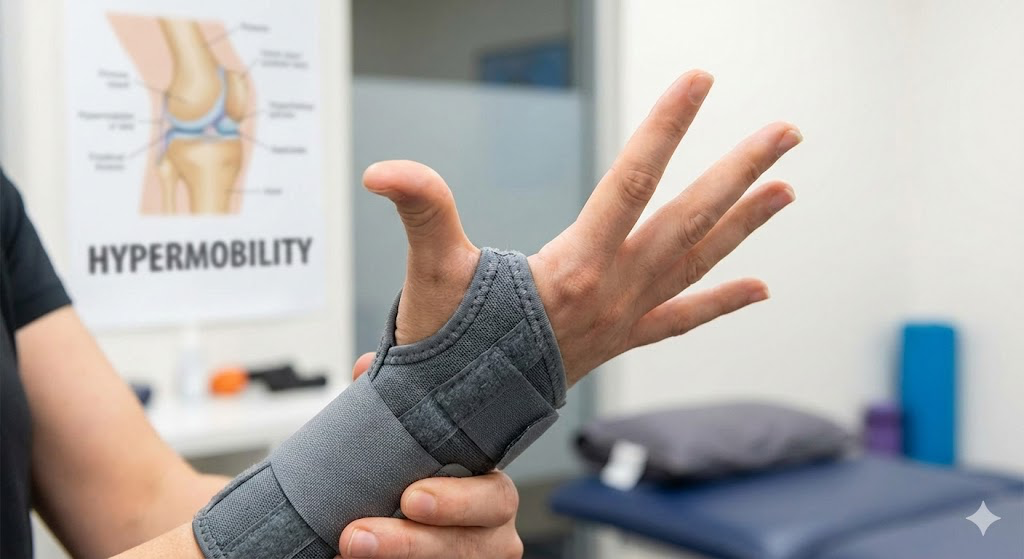
If you’ve ever been called “double-jointed” or find yourself easily performing party tricks with your elbows and thumbs, you might have Generalized Joint Hypermobility (GJH). While often seen as an advantage in dance or gymnastics, a recent study published in Scientific Reports (part of the Nature Portfolio) dives into the hidden costs—and surprising benefits—of being hypermobile.
The study, led by Esedullah Akaras and colleagues, aimed to settle a long-standing debate: does extra flexibility compromise your strength and sense of body position, or do hypermobile individuals simply adapt?
Here is what they found.
1. The Proprioception Problem
The most significant finding concerns proprioception—your body’s ability to sense where it is in space without you looking.
The researchers compared hypermobile individuals with a non-hypermobile control group and found that those with hypermobility had significantly poorer proprioception in both their elbows and knees. Essentially, the “loose” nature of the ligaments may interfere with the sensory feedback mechanoreceptors send to the brain. If you are hypermobile, your internal GPS might be slightly less accurate than average.
2. The Strength Surprise
Common wisdom often suggests that loose joints lead to weakness, but the study paints a different picture.
- No Disadvantage: There was no significant difference in grip strength between the hypermobile and non-hypermobile groups.
- The “Flex” Benefit: Interestingly, within the hypermobile group, higher Beighton scores (a measure of flexibility) were actually correlated with stronger grip strength. The authors suggest that in some contexts, increased joint mobility might mechanically aid force production.
3. Functional Performance & The “Workaround”
Perhaps the most encouraging result came from the functional stability tests (exercises that challenge stability in the upper and lower limbs). despite the deficits in proprioception, the hypermobile group performed just as well as the non-hypermobile group.
How is this possible? The researchers propose that hypermobile bodies are masters of compensation. Even though their internal sensory feedback (proprioception) is “noisy” or inaccurate, they likely adopt alternative motor control strategies to maintain stability and function effectively during tasks.
The Takeaway
This research highlights the “dual nature” of hypermobility. It is not simply a benign trait or a disability; it is a different physiological baseline.
For physios, trainers, and hypermobile individuals, the message is clear: You don’t necessarily need to worry about being “weaker.” However, because your body’s natural position-sensing is dampened, neuromuscular training is vital. Focusing on balance and controlled movement can help you retune that internal GPS and prevent injury, ensuring your flexibility remains a superpower rather than a liability.
