
Resistance Training and Longevity: What a 30-Year Study Found
Article: Long-term resistance training with all-cause and cause-specific mortality: assessing dose-response and joint associations with aerobic physical activity by Zhang et al., British Journal of Sports Medicine (2026).
Summary
This large prospective cohort study examined whether long-term resistance training (strength training/weight training) is associated with lower mortality (longevity), how much training is optimal, and how resistance training interacts with aerobic exercise. Using data from nearly 150,000 US adults followed for up to 30 years, the researchers found that moderate amounts of long-term resistance training were associated with lower risks of death from all causes, cardiovascular disease and neurological diseases, but that benefits generally plateaued at around 90–120 minutes per week. Combining resistance training with aerobic exercise produced the greatest overall reductions in mortality risk.
Background
While the benefits of aerobic exercise for longevity are well established, there has been less clarity regarding:
- Whether resistance training independently reduces mortality.
- The optimal amount of resistance training.
- Whether resistance training adds benefits beyond aerobic exercise.
- Its effects on specific causes of death, particularly neurological diseases.
Previous research suggested that muscle-strengthening activities may reduce mortality risk, but most studies measured exercise only once at baseline and had limited information on long-term training patterns.
Study Design
The study pooled data from three major US cohorts:
- Health Professionals Follow-up Study (HPFS)
- Nurses’ Health Study (NHS)
- Nurses’ Health Study II (NHS II)
After exclusions, the analysis included:
- 147,374 participants
- 31,540 men
- 115,834 women
- Follow-up of up to 30 years
- 35,798 deaths recorded during follow-up.
A key strength was that participants repeatedly reported both resistance training and aerobic exercise over time, allowing researchers to examine long-term habits rather than relying on a single measurement.
Main Findings
1. Resistance Training and All-Cause Mortality
Compared with no resistance training:
| Weekly resistance training | Reduction in all-cause mortality |
|---|---|
| 1–29 min | ~5% |
| 30–59 min | ~9% |
| 60–89 min | ~9% |
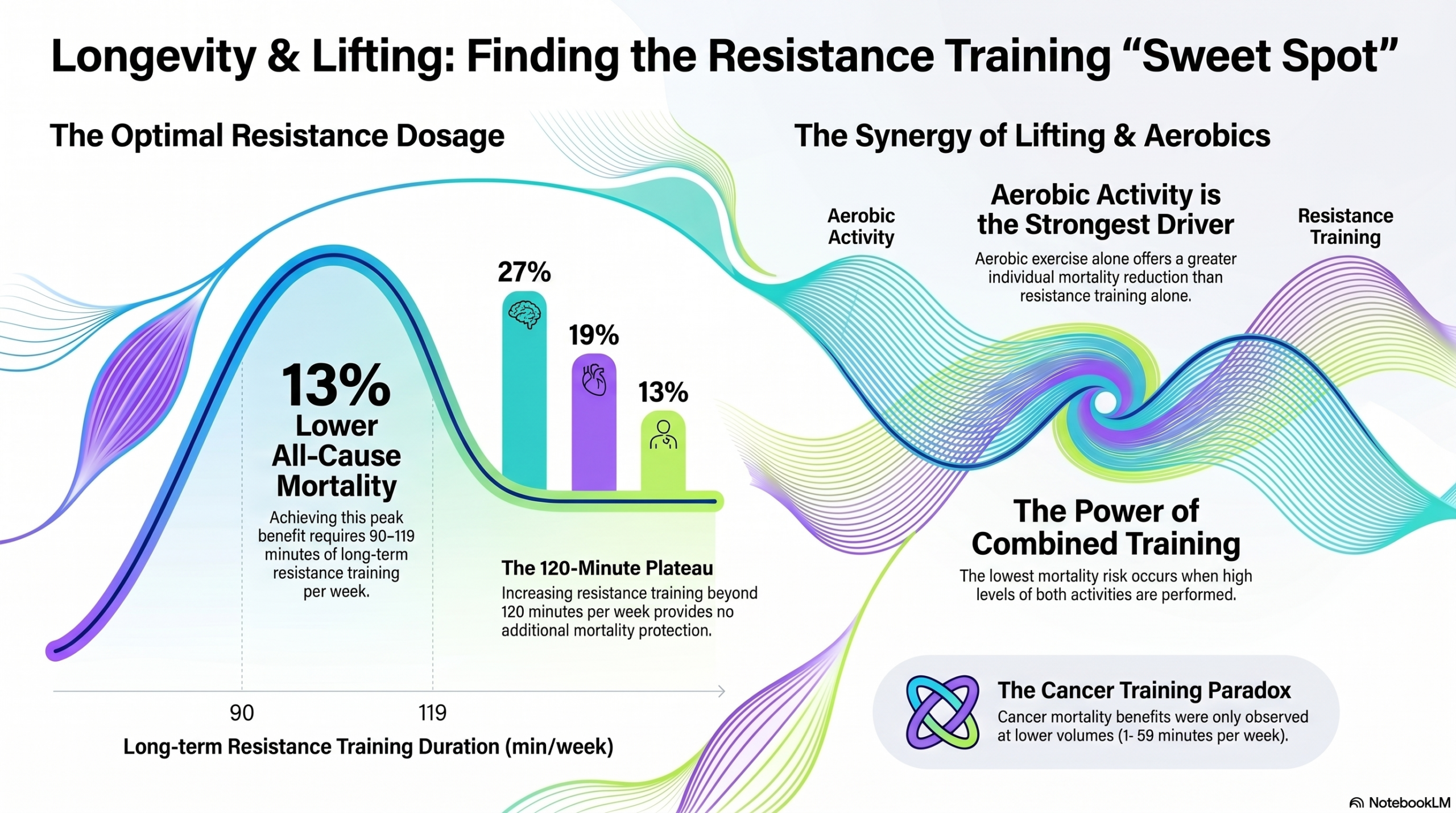
| 90–119 min | ~13% |
| > 20 min | ~8% |
The greatest benefit was observed at approximately 90–119 minutes per week, with no further improvement at higher volumes. This produced a J-shaped or plateauing relationship, suggesting that more is not necessarily better.
2. Cardiovascular Disease Mortality
Resistance training was associated with lower cardiovascular mortality.
The strongest effect was again seen at 90–119 minutes per week, which was associated with:
- 19% lower risk of cardiovascular death
after adjustment for aerobic exercise and other lifestyle factors.
The authors suggest that long-term resistance training may improve vascular health, body composition and metabolic function, thereby lowering cardiovascular risk.
3. Cancer Mortality
The pattern for cancer differed.
Benefits appeared only at relatively low levels of resistance training:
- 1–29 min/week -> 9% lower cancer mortality.
- 30–59 min/week -> 12% lower cancer mortality.
Higher amounts (> 60 min/week) were not associated with further reductions.
The strongest associations appeared for mortality from:
- Colorectal cancer
- Bladder cancer
- Breast cancer
although case numbers for individual cancers were relatively small.
The authors note that the biological explanation for this pattern remains uncertain and requires further investigation.
4. Neurological Disease Mortality
One of the study’s most novel findings was the association with neurological disease mortality.
Participants performing 90–119 minutes/week of resistance training experienced:
- 27% lower risk of death from neurological diseases
compared with those doing none.
Most neurological deaths were related to dementia.
The authors cite evidence from clinical trials showing that resistance training may induce favourable brain changes and potentially reduce neurodegenerative disease risk. However, they emphasise that causality remains uncertain because dementia develops over decades and declining physical activity may itself be an early symptom.
Interaction Between Resistance and Aerobic Exercise
A major aim was to determine whether resistance training adds benefits beyond aerobic activity.
Resistance Training Alone
Among participants who performed little aerobic exercise (<7.5 MET-hours/week):
- Resistance training alone was associated with modest reductions in mortality (approximately 7–11%).
Aerobic Exercise Alone
Aerobic exercise produced substantially larger benefits:
- Mortality risk reductions ranged from approximately 26% to 43%, depending on volume.
Combination of Both
The lowest mortality risks occurred among people who combined substantial aerobic activity with resistance training.
One example:
- 30–45 MET-hours/week of aerobic exercise
- plus 60–119 min/week of resistance training
was associated with:
- 45% lower mortality risk (HR 0.55)
compared with inactive individuals.
Practical Interpretation
The findings suggest a hierarchy:
Best outcome
High aerobic activity plus moderate resistance training.
Very good outcome
High aerobic activity alone.
Better than inactivity
Resistance training alone.
Worst outcome
Low aerobic activity and no resistance training.
Importantly, resistance training continued to add benefits at most levels of aerobic activity, but these additional gains largely disappeared once aerobic activity reached very high levels (> 45 MET-hours/week).
Strengths of the Study
The study has several notable strengths:
- Very large sample size.
- Up to 30 years of follow-up.
- Inclusion of both men and women.
- Repeated measurements of exercise over time.
- Detailed adjustment for smoking, diet, BMI, alcohol intake and other confounders.
- Examination of both all-cause and cause-specific mortality.
Limitations
The authors acknowledge several limitations:
Self-reported exercise
Resistance training was reported by participants rather than measured objectively.
Limited detail
The questionnaires did not capture:
- Training intensity.
- Load lifted.
- Number of sets and repetitions.
- Other forms of strength training such as Pilates or calisthenics.
Population characteristics
Participants were predominantly:
- White
- Middle-aged or older
- Health professionals
which may limit generalisability to other populations.
Observational design
The study can identify associations but cannot definitively prove causation. Healthier people may be more likely to undertake resistance training, despite extensive statistical adjustment.
Key Takeaways
- Moderate long-term resistance training is associated with lower mortality.
- Around 90–120 minutes per week appears to provide the greatest overall benefit.
- More than 120 minutes per week does not appear to confer additional longevity benefits.
- Cardiovascular and neurological mortality show the clearest reductions.
- Cancer mortality benefits are observed mainly at lower levels of resistance training.
- Aerobic exercise remains the stronger predictor of longevity.
- The greatest reduction in mortality risk occurs when resistance training is combined with regular aerobic exercise.
- These findings support current physical activity guidelines recommending both aerobic and muscle-strengthening activities.
Bottom line: For longevity, the evidence from this study suggests that a practical target of roughly 90–120 minutes of resistance training per week alongside regular aerobic exercise may provide near-maximal benefits, while substantially greater volumes of resistance training are unlikely to further reduce mortality risk.
